Precision industry that cannot guess.
Swiss and German manufacturing and process engineering, where a wrong tolerance carries cost and the design data cannot leave the floor.
A stackable unit sized to each client's grid, compute need, and existing building infrastructure, running the deterministic model tuned to that silicon. It sits inside your perimeter and answers in milliseconds.
This is the on-site delivery of the Allodial model: an operating system shaped to one client, running beneath the stack.
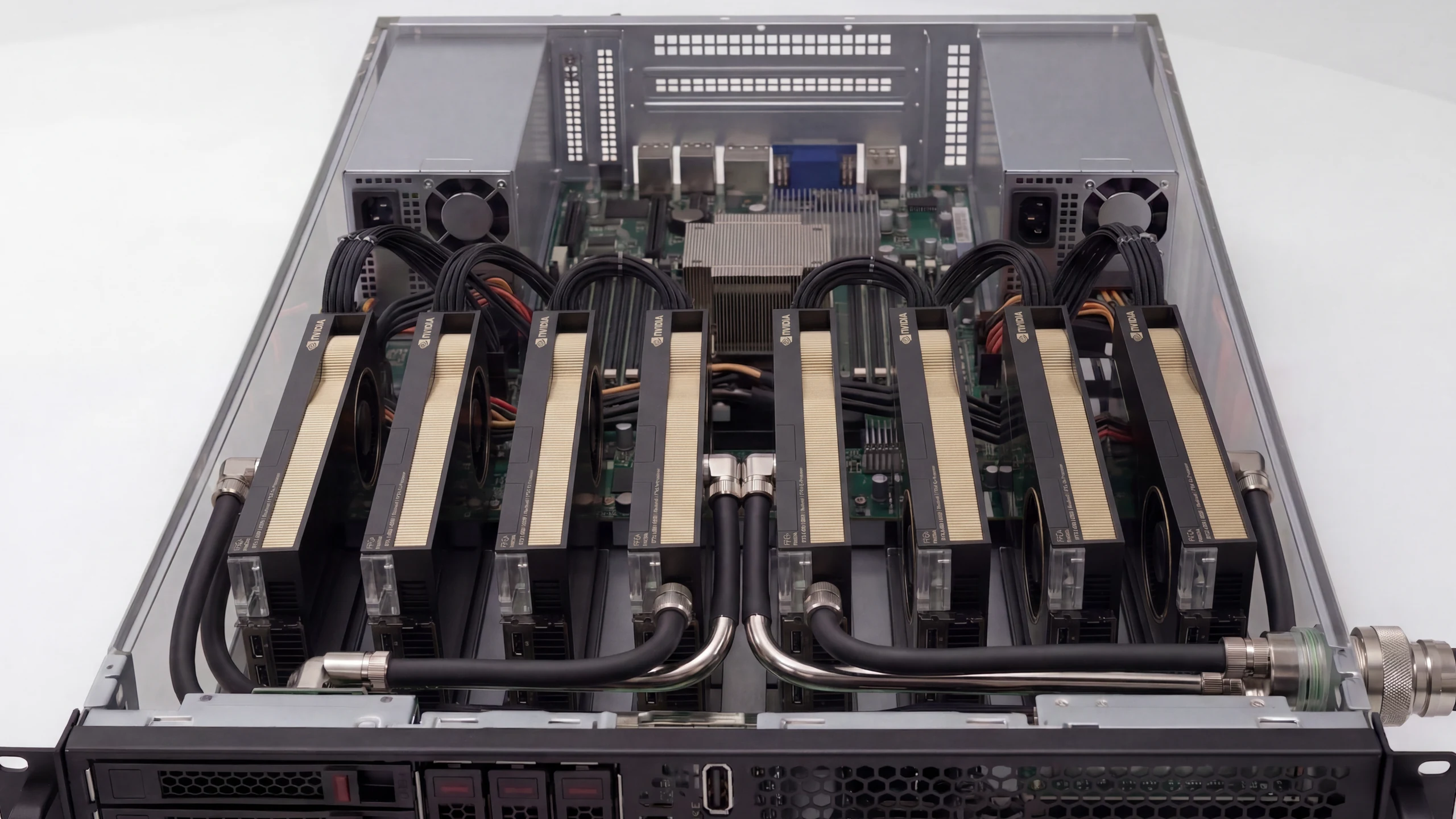
The chassis arrives racked and the model arrives tuned to its GPUs, with the proof stack intact. You power it on behind your firewall and it runs.
The system is integrated into your data, your regulators, and your hardware until it runs beneath everything else. That is what makes the determinism hold on your own floor.
The Allodial 10 kW Furnace carries eight AMD Instinct MI300X and 1.5 TB of HBM3, enough to hold a serious model resident and serve high-volume inference on site. The 7 kW carries eight NVIDIA RTX PRO 6000 Blackwell Server Edition where a lighter node fits the workload. The 3 kW carries two MI300X and draws thirteen amps at two hundred and thirty volts.
Run a frontier model the usual way and the GPUs sit under half used, waiting one token at a time; you are paying for silicon that spends its day idle. Model agnostic. Our Lean4 harness runs your models faster, on hardware that stays local. You bought the compute. Here you use it.
Compute is not why the thermal system exists. A building already moves heat and already has somewhere to put it. The Furnace sits in that path and does work on the way through, which makes the rejection route a siting decision rather than a limit on where it runs.
The node rejects at around forty degrees. A heat pump drawing from that loop instead of from winter air runs at a coefficient of performance in the four to six band rather than two to three, in the season when heat demand peaks. The heat is heat the building was going to buy.
Where a building already carries a borefield, the ground loop takes the rejection year round. There is no seasonal demand to match, and the loop is capital already sunk.
A dry cooler, a tower, or a tie-in to chilled water takes the heat where the first two paths are absent. The economics are the weakest of the three and the deployment is unconditional.
Every step is auditable, and the output carries a formal check you can read. Where a system has to be proven before it ships, the proof is what you are buying.
The model makes no external call, so the data has no path off the premises. The obligations that attach to moving data across borders have nothing here to attach to. Full hash-to-hash bit transparency and traceability on compute makes data residency and auditability provable, which is what GDPR asks you to demonstrate.
You own the hardware, so the cost is fixed the day the node arrives. With no counterparty to meter the inference or the storage, asking the model more costs only electricity.
It also retires a cost most buyers forget to price. Output that carries its own formal check removes the human confirmation step that unchecked systems require, and that step is billable. Under sustained load the hardware earns its cost back, and what it earns after that is margin.
Swiss and German manufacturing and process engineering, where a wrong tolerance carries cost and the design data cannot leave the floor.
Trading and risk desks where the same input must reproduce the same result, and no position touches an outside API.
Legal and compliance teams that need every output traceable and every document held inside privilege, with no processor in the chain.
Public-sector and sovereign deployments where data residency is law and an air-gapped, deterministic system is the one that clears.
We size the node to your workload and your regulators, then deliver it ready to run. Configuration and commercial terms come on request.